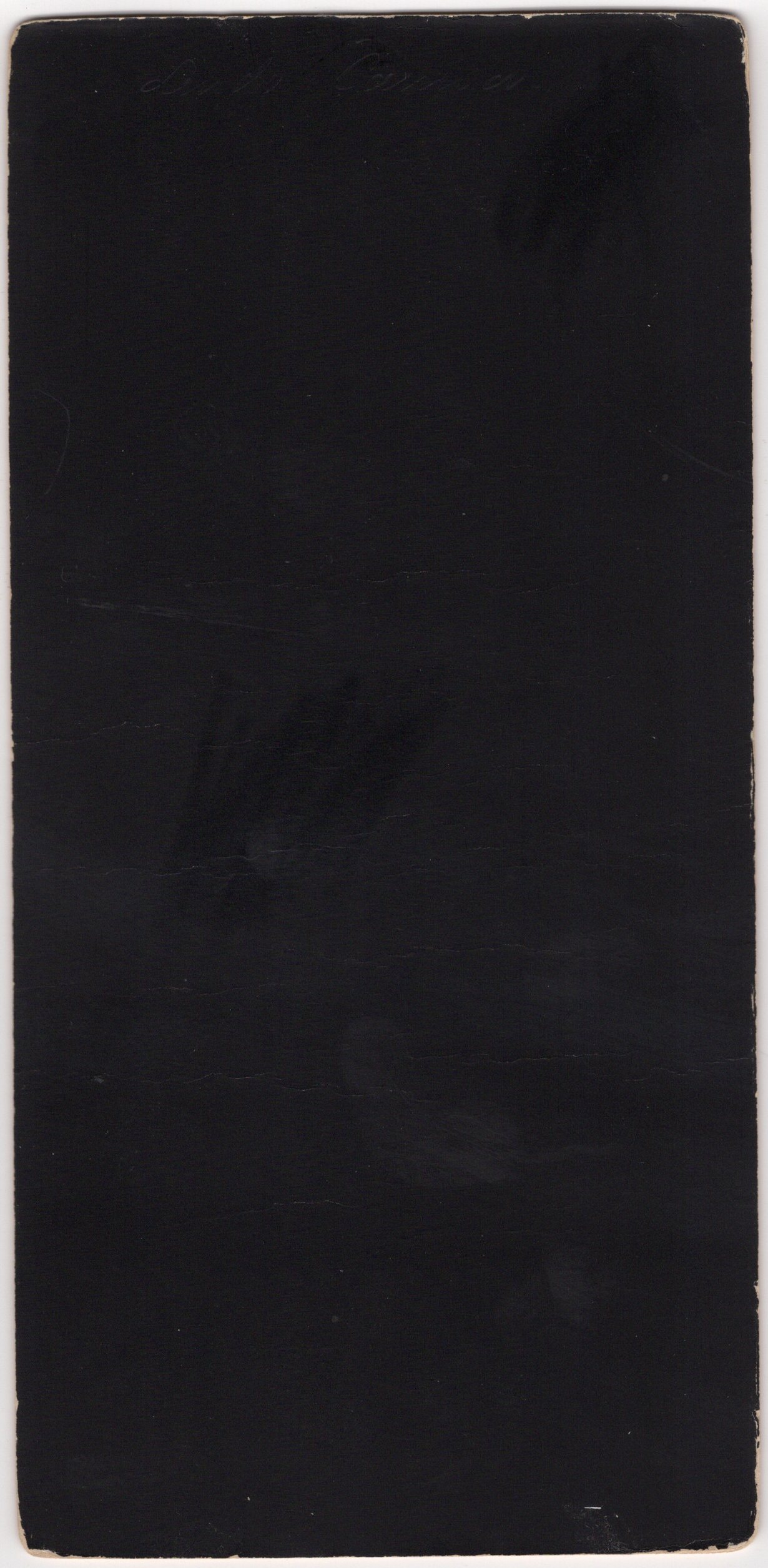
This beautiful late nineteenth-century cabinet card presents a wonderfully staged winter scene by Frank C. Weston of Bangor, Maine. The New York Public Library’s Photographers’ Identities Catalog lists Frank C. Weston as born in 1852 and records his studio locations in Bangor, including 2 Smith Block and, by 1905, 23 Hammond Street. Weston was a native of Maine who established himself as a photographer in the late 1870’s. His prices were “dictated by a spirit of moderation”, and he was the preferred photographer among the African American community of Bangor. This image shows two young girls posed in a snowy studio landscape, dressed in matching dark winter outfits with capes, buttoned dresses, dark stockings, boots, scarves, and fur-trimmed or heavy winter hats. They stand solemnly and formally, as children so often did in Victorian-era studio portraits, but the scene itself is wonderfully playful. Beside them is a small sled or sleigh, and on it is a small shaggy dog, likely posed as part of the winter tableau. The girls appear to be holding reins or cords attached to the sled, creating the charming illusion that the girls are pulling the sleigh through the snow. The painted studio backdrop includes bare winter trees, a snow-covered fence, and a dramatic wintry sky, giving the portrait a storybook quality. This is more than a simple child portrait; it is a carefully composed Victorian winter play scene. The combination of children, sled, dog, snow, and painted outdoor scenery gives the image strong appeal. It has the feel of a staged seasonal fantasy, perhaps intended to evoke Bangor’s cold Maine winters while also presenting the children in a refined and sentimental manner. Bangor itself was an important and prosperous Maine city during this period. In the nineteenth century it was deeply connected to the lumber trade, with Maine Memory Network noting that Bangor exported more lumber than any other port in the world in 1842, and that the Penobscot region saw another boom in the 1880s with the rise of the paper industry. That prosperity helps explain why a photographer such as Weston would have had a clientele for elaborate studio portraits such as this one. The reverse of the cabinet card is especially interesting. Rather than a plain blank back, it has a large, subtle, blind-embossed studio backstamp or advertising impression for Weston. It is somewhat faint but it gives the card an added layer of interest. This kind of subdued, impressed backmark is less visually bold than the ornate printed backs often seen on cabinet cards, but it is quite appealing and somewhat unusual. It also helps confirm the photographer and Bangor origin. SOLD
TOURO SYNAGOGUE : NEW ORLEANS, LA : JUDAICA : JEWISH LANDMARK : POSTCARD c1911

This early 20th-century postcard presents a beautifully hand-colored depiction of the Touro Synagogue in New Orleans, Louisiana, a historic and architecturally stunning place of worship. The front of the postcard showcases the grand Byzantine Revival and Romanesque architecture of the synagogue, with its impressive arched windows, intricate detailing, and massive domed roof. The exterior is adorned with yellow and tan hues, accentuating the decorative brickwork and stone elements. The three arched entryways, flanked by ornamental lamps, create a striking entrance, while the large stained-glass window dominates the façade, casting light into the sacred space within. Surrounding the synagogue are elegant, early 20th-century residential buildings, adding to the historical ambiance of the scene. The neatly paved sidewalks and tree-lined street complete the picturesque setting, capturing a moment in time when this spiritual landmark stood as a beacon for the Jewish community of New Orleans. The reverse side of the postcard remains unused. The S.H. Kress & Co. imprint on the left edge indicates that this card was published by the well-known five-and-dime store chain, which often produced high-quality postcards featuring landmarks across the United States. The Touro Synagogue holds a significant place in American Jewish history. Its origins date back to the early 19th century, making it one of the oldest Jewish congregations in the United States. The congregation was formed through the merger of two older congregations—Nefutzot Yehudah (1845) and Shanarai-Chasset (1828)—both serving Jewish immigrants who had settled in the bustling port city of New Orleans. The building depicted in this postcard was constructed in 1908–1910, replacing an earlier structure. Designed by renowned architect Emile Weil, the synagogue exemplifies the grandeur of early 20th-century Jewish architecture, blending elements of Byzantine and Romanesque styles to create an awe-inspiring place of worship. The Touro Synagogue still stands today and remains an active center for Jewish worship in New Orleans. It continues to serve the Reform Jewish community, upholding its rich traditions while adapting to modern times. Over the years, it has undergone renovations to preserve its historic and architectural significance. This postcard is from circa 1911. SOLD
BILLIE DOVE: BEAUTIFUL FILM ACTRESS, GIRLFRIEND OF FLORENZ ZIEGFELD : RPPC
POSTCARD 2 (SOLD)
POSTCARD 3 (SOLD)

POSTCARD 4 (SOLD)
These vintage real photo postcards feature actress Billie Dove. Billie Dove (1903-1997) was an American actress. Her parents were Swiss immigrants. During her teenage years, she worked as a model to support her family. Florenz Ziegfeld hired her as a teenager to appear in the Ziegfeld Follies Revue. She was not a particularly talented dancer or singer, her beauty and acting ability were her major assets. In the early 1920’s she moved to Hollywood and began appearing in silent films. It has been written that Ziegfeld’s wife, actress Billie Burke, helped facilitate Dove’s transition to films. Apparently, Burke was trying to separate Dove from her husband because the pair were having an affair. It did not take long for her to become one of the more popular actresses of the 1920’s. Among her better known films was “The Black Pirate” (1926) with Douglas Fairbanks, and “The American Beauty” (1927). Dove was a ravishing beauty and was very photogenic. She married director, Irvin Willat, in 1923. The marriage had a six year duration. She then had a three year romance with Howard Hughes. Dove’s other interests included being a pilot, painter, and poet. After her last film, “Blondie of the Follies” (1932), Dove retired from films. It is thought that she retired because she was distraught about her role in her last film being “trimmed” by her co-star’s (Marion Davies) influential boyfriend (William Randloph Hearst). Hearst was upset because Miss Davise’s acting was overshadowed by Dove’s acting. Mr Hearst owned Cosmopolitan Productions which produced the movie. After retirement, Dove married oil executive Robert Kenaston in 1933 and the couple remained together until Kenaston’s death in 1970. She had a brief third marriage to an architect. It is interesting to note that jazz singer, Billie Holiday, borrowed Billie Dove’s first name when picking out her own stage name. Miss Holiday was an admirer of Miss Dove. The IMDb lists 50 movie credits for Billie Dove between 1921 and 1962.
Postcard 1 is a profile portrait was published by Cinemagazine – Paris Edition (no.313). (SOLD)
Postcard 2 was published as by Ross Verlag as part of a series (No.3687/1). Billie Dove looks beautiful in this portrait taken by Defina. The logo for First National Pictures can be seen in the image’s lower right corner. (SOLD)
Postcard 3 features Billie Dove looking beautiful in this provocative portrait. The card is risque, considering Dove’s pose and revealing tight dress. Billie Doves portrait seen on this postcard was taken by Defina. This card was published by Ross Verlag’s Italian Edition (Bellerini & Fratini, Florence, Italy). Casa Editrice Bellerini & Fratini was one of the most renowned Italian publishers. The firm began publishing film postcards in the early 1920’s and later became a distributor for Ross Verlag. As of 1918, the firm was still in existence. (SOLD)
Postcard 4 accentuates Billie Dove’s beauty and elegance. She is reclining gracefully on an ornate, upholstered sofa. Her expression is soft and alluring, with a slightly playful or flirtatious gaze directed toward the camera. She is wearing a light, likely beaded or embellished, sleeveless gown that exudes 1920s sophistication and glamour. A long, delicate strand of pearls adorns her neck, adding to the vintage style and suggesting wealth or high social status. Her accessories include dangling earrings, a bracelet, and what looks like a feather boa or decorative fur near her arm. Her hair is styled in the characteristic short, wavy fashion of the 1920s. Her makeup is subtle yet elegant, with attention to her eyes and lips to accentuate her facial features. The atmosphere is glamorous and romantic. The soft pose and luxurious backdrop suggest themes of wealth, fame, and vintage Hollywood allure. The sofa has an intricate pattern that matches the era’s lavish interior design aesthetic. The background fabric and curtains complement the overall tone of refinement. This postcard was published by Ross Verlag (Berlin, Germany) as part of a series (no.4305/1). SOLD
POSTCARD 1
POSTCARD 2 (SOLD)
POSTCARD 3

POSTCARD 4
CARNAVAL : NICE, FRANCE : THE MERMAID & FISHERMEN FLOAT : HISTORICAL : RPPC 1924


This vintage postcard features a photograph of the carnaval that was held in Nice, France in the year 1924. In the center of the photograph is a beautiful elaborate float that displays a mermaid and fishermen. The scene is packed with spectators there to celebrate the event. This unused postcard was published by Levy & Neurdein Reunis (Paris, France). SOLD
ADORABLE SIBLINGS : MENASHA, WISCONSIN : BEAUTIFUL CABINET CARD PORTRAIT
Three beautiful children pose for their portrait at at the Lockwood studio in Menasha, Wisconsin. The children are most likely siblings and judging by their fashionable outfits, they appear to be from a well-to-do family. SOLD
CUTE BOY AND HIS DOG “SPOT” : JOHN WINTERS NEILL : PHILADELPHIA, PA. : CAB CARD
This charming late 19th-century cabinet card shows a young boy standing beside his faithful dog. The child—identified in handwriting on the reverse as John Winters Neill, age 5 years old—poses solemnly next to his canine companion, “Spot,” age 3 years old. John stands with one hand resting gently on Spot’s back, his other hand holding a small riding crop or stick. His attire is typical for a well-dressed boy of the 1880s or early 1890s: a patterned blouse with an oversized bow tie and a pleated kilt-style skirt worn over dark stockings and button-up leather boots. Spot, likely a Collie mix, sits obediently at his side, gazing steadily toward the camera. The painted studio backdrop, with flowers and a rustic staircase, enhances the portrait’s home-garden atmosphere. The photographer is identified as the Marshall studio, a Philadelphia firm active during the late 19th century. His studio operated on Ridge Avenue in Philadelphia. The reverse of the card carries the handwritten note: “John Winters Neill, age 5 years old and dog Spot age 3 years old”. This inscription likely came from a family member or studio assistant, serving as an identifying caption for personal or archival use. During the Victorian and early Edwardian periods, it was quite fashionable to include pets—especially dogs in children’s portraits. Such compositions symbolized loyalty, innocence, and the bonds of companionship. (SOLD)

SWEET LITTLE BOY : ADORABLY DRESSED : SAILOR SUIT : RPPC 1924-1949
This vintage real photo postcard features a sweet little boy wearing a sailor suit with short pants. He is adorable. He has a hand on an adjacent chair as he looks at and smile at the photographer. Judging by his complexion, the little boy may be from an unidentified ethnic group. (SOLD)
ADORABLE GIRL WITH RIBBONS : G.J. VREELAND : ENID OKLAHOMA :SON OF ROSA VREELAND
This charming vintage photograph, measuring 6 x 4.25 inches, captures a young girl in the early 20th century, posed confidently with one hand resting on a carved-back wooden chair. Her stance, with one leg raised onto the chair’s rung, gives the image a spirited and slightly playful energy—suggesting a child comfortable in front of the camera. Her expression is calm and composed, with the faintest trace of a smile playing at the corners of her lips, giving her a sense of self-possession that is rare in children’s portraiture of the period.She wears a delightful checked dress with a high, ruffled collar and full sleeves gathered at the wrists. The dress is decorated with bands of detailed horizontal pleating and lacework near the hem, a popular style for girls in the Edwardian era. Her long hair, parted down the middle and styled into loose waves, is adorned with two large white hair bows—adding a delicate and feminine touch. She wears dark stockings and ankle-high leather button-up boots, typical of children’s fashion of the 1900s. The photograph was taken by George J. Vreeland, a professional photographer based in Enid, Oklahoma, whose elegant studio mark appears in the lower right corner of the original mount. George J. Vreeland was part of a photographic lineage—his mother, Rosa Vreeland, was a pioneering woman in the field of photography. Her career spanned over three decades during the late 19th and early 20th centuries. She began her photographic journey in 1881 in McPherson, Kansas, establishing herself as a skilled artisan photographer and entrepreneurial studio owner. Throughout her career, she operated studios in various locations, including Salina, Hutchinson, and Marion in Kansas, as well as Colorado Springs, Colorado. Around 1901, she relocated to Alva, Oklahoma, where she continued her photographic work under the Vreeland Studio name. Rosa operated her own studio during a time when few women worked in this profession and earned a reputation for her technical skill and artistry behind the camera. She undoubtedly influenced her son’s work, and her legacy lives on in portraits such as this—well-composed, gently lit, and full of personality. The mount itself is beautifully decorated with pressed, embossed scrollwork framing the photograph, further emphasizing the image’s refined presentation. SOLD
CHARMING PORTRAIT OF A YOUNG GIRL : HUNTINGTON, LONG ISLAND, N.Y. : CABINET CARD
This captivating cabinet card features a young girl captured in the Huntington, New York studio of Frederick H. Lockwood, a renowned local photographer of the late 19th and early 20th centuries. The girl in the photograph exudes an air of refined innocence and quiet sophistication. Her long, wavy hair cascades over her shoulders, meticulously styled to reflect the beauty standards of the Victorian era. She wears an elaborately detailed coat, finely tailored with textured fabric, which adds depth to her overall appearance. A large, dramatic hat adorned with an extravagant plume sits proudly atop her head. Her gloves, tightly clasped in her hands, and the patterned fabric draped over her lap suggest a sense of composure and decorum. The girl’s expression is serene, almost wistful, her gaze turned slightly to the side as though she’s lost in thought or caught in a fleeting moment of daydreaming. Her subtle smile and delicate jewelry, including modest earrings, reflect a reserved yet genteel personality—perhaps a young lady of a well-to-do family. This photograph originates from the studio of Frederick Lockwood in Huntington, New York. SOLD